AI project failure rates are still painfully high in 2026. Multiple reports point to the same picture: Around 80% of AI projects fail to deliver business value. 95% of GenAI pilots are abandoned. Leadership alignment issues are behind 84% of failures. Only 21% of leaders report significant positive ROI from AI. Gartner also estimates that 60% of unsupported AI projects will be abandoned by the end of 2026.
At this point, the failure data is no longer surprising. What is surprising is that many companies are still explaining it with the wrong reasons: data readiness, unclear KPIs, not enough experimentation. Those matter. But they are not the heart of the problem.
AI projects fail because the managers who need to operationalize them were never truly designed into the rollout. And that matters because this is where strategy either becomes execution - or quietly dies.
HBR recently framed it well in “Managers and Executives Disagree on AI - and It’s Costing Companies” (April 2026): executives tend to experience AI as strategic opportunity, while middle managers experience it inside real workflows, under real constraints, with real pressure, and often without enough support.
That gap between executive ambition and managerial reality is, in my view, one of the biggest reasons AI ROI is stalling. And it will not be solved with another strategy deck. It will not be solved with mandatory training alone.
It starts by supporting managers in the actual moment of decision-making. Because once managers experience AI in a practical, personal, on-the-job way - once they actually save time, make better decisions, or see clearer execution - adoption becomes real. And from there, improvement expands into the broader business process.
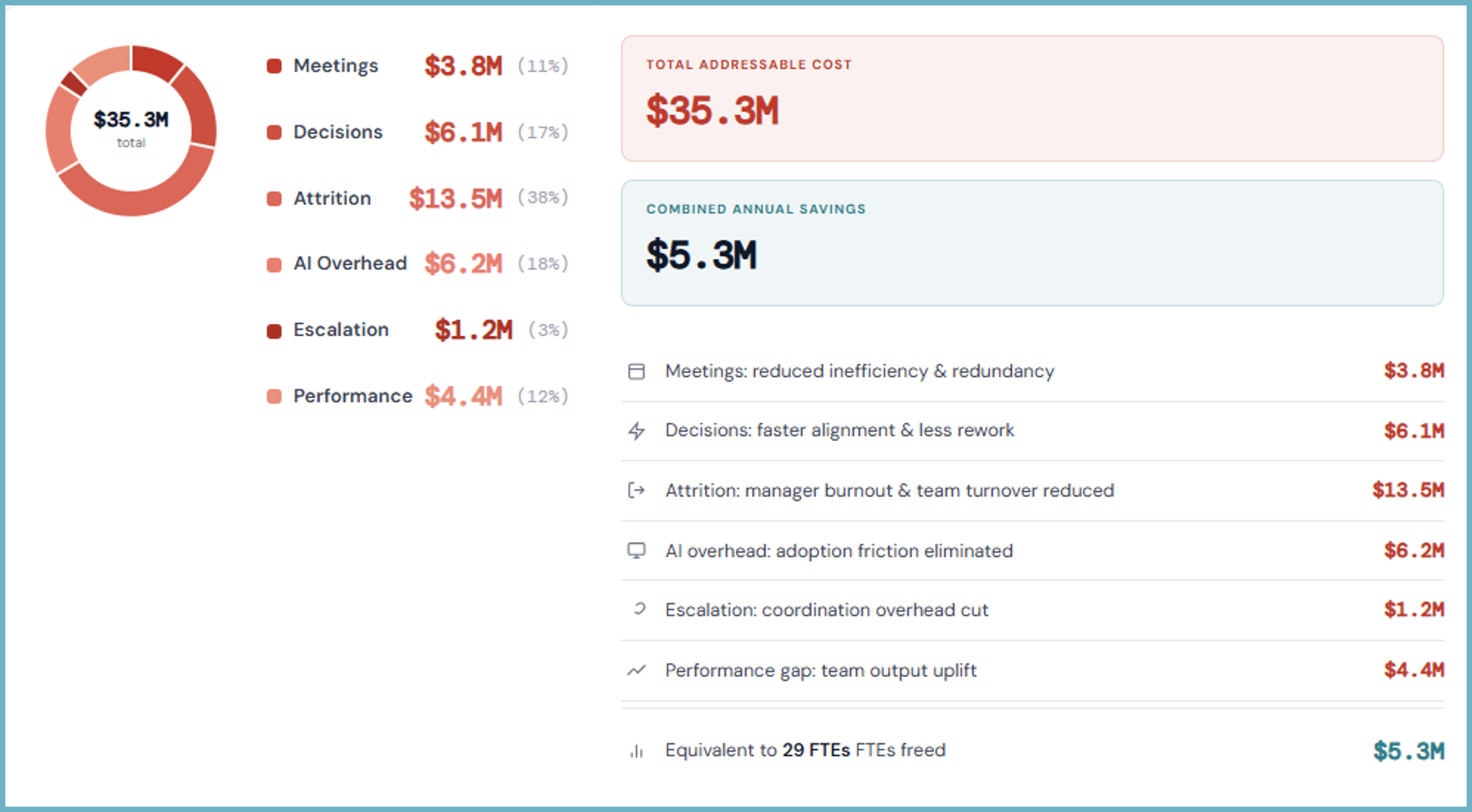
One example we recently discussed with a customer made this painfully tangible: A cyber company with 750 employees. 150 managers. 12% annual attrition. Average salary of $120K. Around 10 meeting hours per week per manager, with an estimated 15% of that time redundant. When you calculate the cost of unsupported management at the moments of decision, the exposure is more than $30M per year. $30M! And this is not abstract. It shows up in attrition, decision latency, meeting waste, and slow AI adoption.
Even modest and very conservative improvement can create major value. Just by supporting mid-level managers in real time, that company could potentially save $5M+ per year.
That is the real wake-up call.
If you want AI ROI, do not start only with the technology. Start with the layer that turns ambition into execution. Support your mid-level managers at the moments that matter.
I added the calculator in the first comment for anyone who wants to test the numbers on their own company. Sometimes the cost is much higher than it looks from the top.