(Prefer to listen? go to the YouTube channel: https://youtu.be/v0M8vfAtNLo)
This week I listened to Adam Foroughi, AppLovin’s CEO, on 20VC. (link in the first comment).
The numbers are almost unreal.
AppLovin reported $5.48B in 2025 revenue, up 70% year over year, with $4.51B adjusted EBITDA and an 84% adjusted EBITDA margin guidance for Q1 2026.
According to its 2025 10-K, the company had 898 employees at the end of 2025.
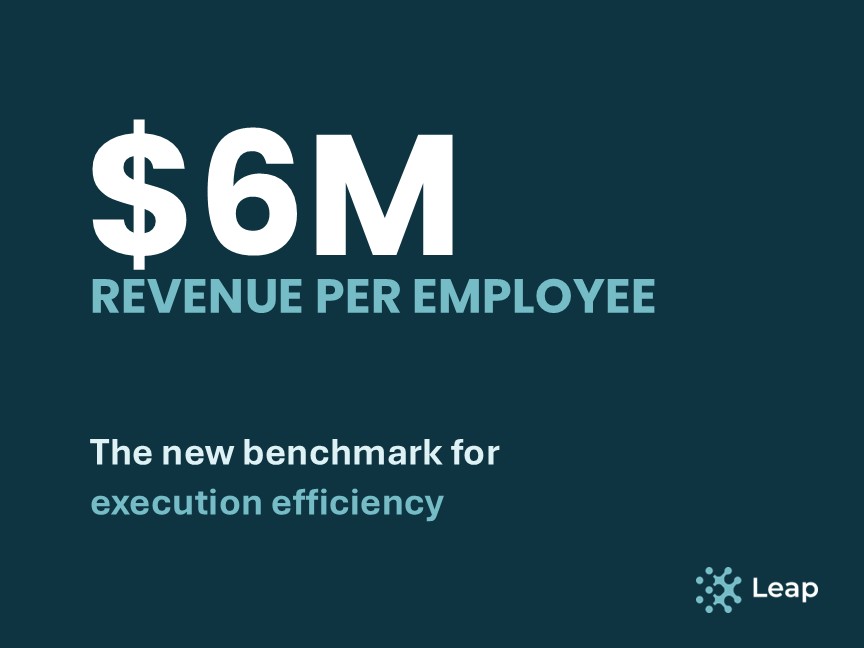
Depending on how you calculate it, this is roughly $6M revenue per employee.
So naturally, everyone asks: How do we become AppLovin?
The easy answer is: “Hire only A players.” “Cut bureaucracy.” “Use AI.” “Reduce headcount.” “Move faster.”
But I think this misses the real lesson.
AppLovin is not impressive because it reduced people. It is impressive because it reduced organizational drag.
That is a very different thing.
There is a dangerous interpretation of the AppLovin story: “Let’s cut the middle.” “Let’s remove HR.” “Let’s expect everyone to self-manage.” “Let’s call it AI efficiency.”
This may work in a very specific culture, with a very specific founder, in a very specific business model, at a very specific moment.
But for most companies, simply copying the visible moves will not create AppLovin-like output. It will create confusion, fear, slower decisions, and hidden execution gaps.
The real question is not: How many people can we remove?
The real question is: How much friction can we remove from the work?
Because productivity per employee is not only a talent metric. It is an execution-system metric.
A company becomes highly productive when:
People know what matters. Decisions are made fast. Ownership is clear. Meetings move work forward. Processes do not require ten approvals. Managers do not spend their week translating strategy into actions manually. AI is not a side experiment - it is embedded into how work actually gets done.
This is where most companies are still stuck.
Executives experience AI as strategy. Managers experience AI as more work.
They are asked to adopt new tools, redesign workflows, manage anxious teams, improve productivity, reduce costs, keep people engaged, and still deliver the number.
But the actual managerial environment has not changed enough.
The middle layer is expected to become dramatically more efficient - while still working inside old calendars, old meetings, old decision habits, old reporting systems, and old approval flows.
That is not an AI transformation. That is asking people to run a Formula 1 race with a family car.
This connects to a larger trend I keep seeing this week: the conversation around managers is shifting from “leadership style” to job design. The digest you shared points to the same direction: manager burnout, AI adoption friction, stalled AI ROI, and the “frozen middle” are increasingly being discussed as structural workflow problems, not personal resilience problems.
And that is the real AppLovin lesson for me.
Not: “Be ruthless.” Not: “Fire more.” Not: “Only keep A players.”
The lesson is:
Design the organization so execution has fewer places to hide.
If a meeting does not move a decision forward - see it. If ownership is unclear - see it. If the process is slowing the team - see it. If managers are spending time on coordination instead of judgment - redesign it. If AI is not connected to business outcomes - stop counting usage and start measuring execution.
The future will not belong to companies with the most AI tools.
It will belong to companies that know how to turn human judgment, AI capability, and operational clarity into faster execution.
That is what AppLovin teaches us.
Not that people do not matter.
The opposite.
People matter so much that we can no longer afford to bury them under broken work.
For me,
Productivity per employee is not a talent metric only, it is an operating-system metric.
This is the heart of the next leadership chapter: not more inspiration, not more workshops, not more dashboards - but better execution architecture around managers, inside the flow of work.