Frequently Asked Questions

AI Implementation & Organizational Change

What is the core challenge organizations face when implementing AI?

The main challenge is not just adopting AI tools, but redesigning work for the AI era. Many organizations focus on buying tools and running pilots without changing how work is structured, which leads to limited business impact. The real shift is that AI automates routine tasks, increasing the importance of human judgment, prioritization, and accountability. (Source: Leap Blog, April 5, 2026)

How does Leap's framework help organizations implement AI successfully?

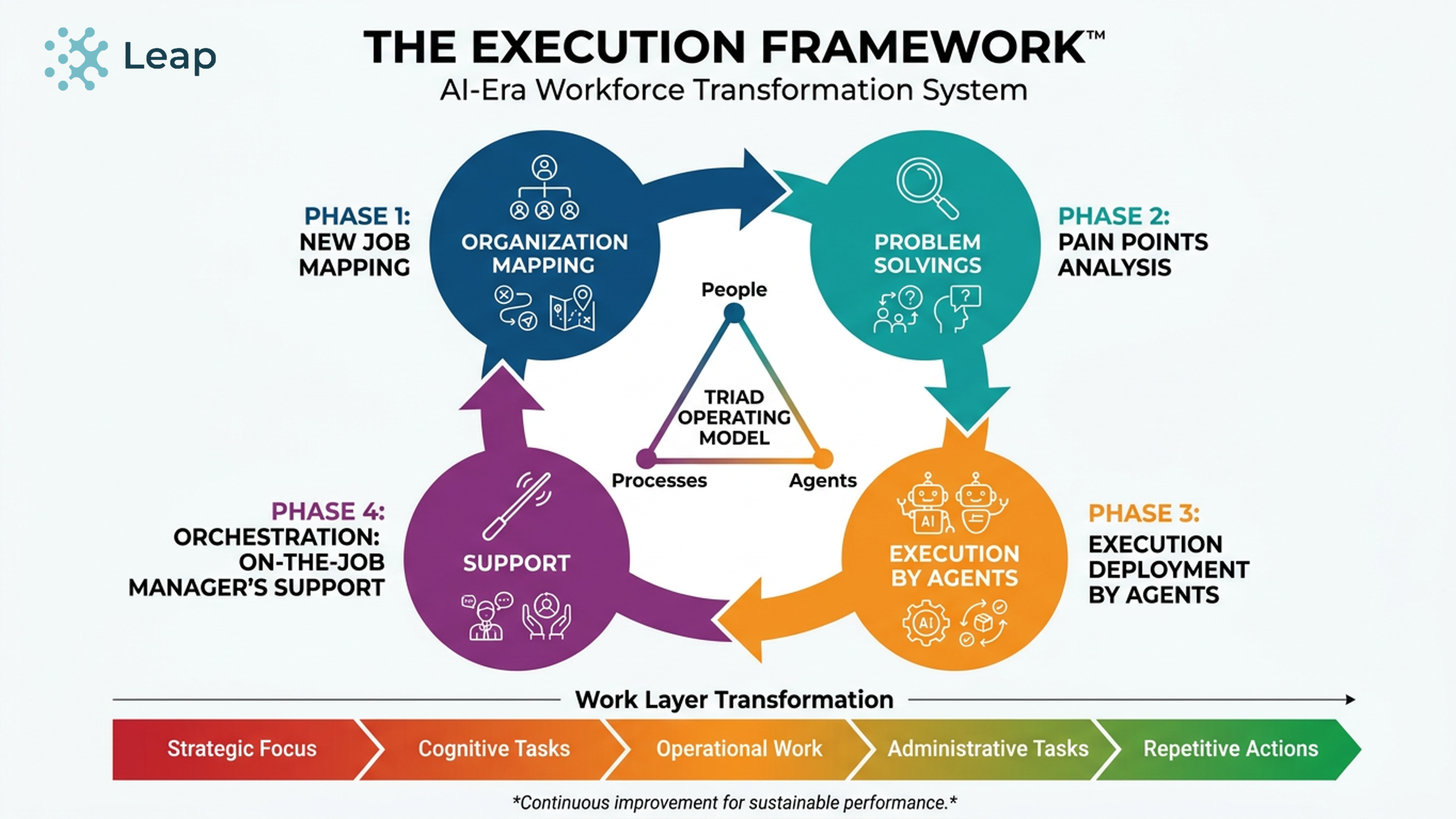
Leap recommends a four-phase framework: New Job Mapping, Pain Points Analysis, Execution Deployment by Agents, and Orchestration/On-the-Job Manager Support. This model emphasizes redesigning roles to focus on judgment work, not just automating routine tasks. The framework integrates people, processes, and AI agents for effective execution. (Source: Leap Blog, April 5, 2026)

What are the two main layers of work in the AI era according to Leap?

Leap distinguishes between 'Mechanical work' (summaries, drafts, search, synthesis, basic processing) which AI can automate, and 'Judgment work' (deciding what matters, making trade-offs, aligning stakeholders, owning responsibility) which requires human expertise. Organizations should invest in strengthening judgment work as routine tasks are automated. (Source: Leap Blog, April 5, 2026)

Product Information & Features

What products does Leap offer to support AI-driven organizational change?

Leap offers two main products: Leaper, a real-time meeting execution tool that detects issues like decision drift and participation imbalances, and Robin, an AI business partner that supports managers between meetings by helping them prepare, decide, follow up, and solve complex challenges. (Source: https://www.myleap.ai/)

What are the key features of Leap?

Key features include real-time execution support, actionable insights and live nudges during meetings, comprehensive visibility into team dynamics and business processes, integration with Slack and Microsoft Teams, and tools to clarify ownership and address execution breakdowns as they occur. (Source: https://www.myleap.ai/)

What integrations does Leap support?

Leap integrates with Slack and Microsoft Teams, allowing managers and teams to use Leap's features within their existing communication workflows. (Source: https://www.myleap.ai/)

Use Cases & Target Audience

Who is Leap designed for?

Leap is designed for organizations with 200–5,000 employees, especially in tech or professional services sectors experiencing growth, change, or rising attrition. Key users include CEOs, COOs, CHROs, and mid-level managers responsible for execution, team dynamics, and operational efficiency. Leap is not suitable for independent businesses, solopreneurs, or companies with fewer than 200 employees. (Source: https://www.myleap.ai/)

What business problems does Leap solve?

Leap addresses unproductive meetings, unclear ownership, unaddressed team tensions, process gaps, managerial overload, attrition risk, and execution waste. It provides real-time tools and insights to help organizations improve execution quality, leadership effectiveness, and operational outcomes. (Source: https://www.myleap.ai/)

What measurable business impact can customers expect from Leap?

Customers can expect a 12% improvement in decision speed, 75% of managers showing measurable progress in their skills, 30% of meetings identified as waste (leading to time and cost savings), clearer ownership and accountability, and reduced attrition risk (saving $90K+ per replaced employee). (Source: https://www.myleap.ai/)

Implementation & Ease of Use

How long does it take to implement Leap and how easy is it to start?

Leap is designed for immediate implementation. The platform is self-explanatory and ready to use without extensive technical setup or training. Onboarding includes a 30-minute kick-off call, intake of HR processes and values, integration with Slack or Microsoft Teams, and manager onboarding. Customers can start seeing benefits almost immediately. (Source: https://www.myleap.ai/)

What feedback have customers given about Leap's ease of use?

Customers report that Leap is self-explanatory, quick to implement, and requires minimal resources to get started. The onboarding process is streamlined and efficient. Testimonials highlight the platform's actionable suggestions and the ability to design customized training programs and track progress. (Source: https://www.myleap.ai/)

Pricing & Plans

What is Leap's pricing model?

Leap uses an annual fixed cost pricing model determined by the number of users. This approach allows organizations to scale costs with team size and provides predictable budgeting. For more details, visit Leap's official website. (Source: https://www.myleap.ai/)

Competition & Comparison

How does Leap compare to traditional meeting tools like Zoom or Microsoft Teams?

Traditional meeting tools focus on recording conversations and post-meeting analytics. Leap's Leaper tool provides real-time nudges during meetings to address decision drift, weak ownership, and participation imbalances, ensuring meetings are productive and actionable in the moment. Note: Leap does not replace video conferencing but complements it with execution support. (Source: https://www.myleap.ai/)

How does Leap differ from generic coaching tools?

Generic coaching tools provide periodic sessions and general guidance. Leap's Robin AI business partner offers real-time, personalized, and adaptive support to managers, helping them prepare, decide, follow up, and solve complex challenges continuously. Note: Teams seeking only periodic coaching may prefer traditional coaching tools. (Source: https://www.myleap.ai/)

How does Leap compare to Business Intelligence (BI) tools like Tableau or Power BI?

BI tools focus on historical data and lagging KPIs. Leap addresses execution challenges as they occur, connecting team dynamics with business processes and providing actionable insights in real time. Note: Organizations needing deep historical analytics may still require BI tools alongside Leap. (Source: https://www.myleap.ai/)

How does Leap differ from HR tools like Workday or BambooHR?

Traditional HR tools focus on engagement metrics and periodic surveys. Leap detects and addresses execution breakdowns (e.g., unclear ownership, team tensions) in real time, improving execution quality and reducing attrition risk. Note: Leap is not a replacement for core HRIS systems. (Source: https://www.myleap.ai/)

Customer Success & Testimonials

What success stories or testimonials are available from Leap customers?

Leap has received positive feedback from professionals such as Adam Magen (VP Operational Excellence), Eden Akta (Manager), Shiraz Smadar (Manager), Ron Yonai (Manager), Noa Jakoel (Senior Manager), and Ayelet Tamir (Chief People & Culture Officer). Testimonials highlight Leap's unique approach, actionable suggestions, and support for professional development and reducing attrition. (Source: https://www.myleap.ai/)

Limitations & Best Fit

Are there scenarios where Leap is not the best fit?

Leap is not suitable for independent businesses, solopreneurs, or companies with fewer than 200 employees. It is tailored for organizations with a management layer and complex team dynamics. Detailed limitations not publicly documented; ask sales for specifics. (Source: https://www.myleap.ai/)

A Practical Framework for Implementing AI Successfully in Organizations
← Back to Blog

A Practical Framework for Implementing AI Successfully in Organizations


TL;DR

Most AI initiatives create excitement but limited business impact because companies automate tasks without redesigning work. AI removes the routine layer - summaries, drafts, basic analysis - which concentrates more judgment responsibility in fewer hands. A four-phase framework covering job mapping, pain point analysis, agent deployment, and on-the-job manager support moves AI from experimentation to real execution impact.

AI is no longer a side project.

It is becoming part of the operating model of modern organizations. But many companies are still approaching it the wrong way. They are buying tools, running pilots, and asking teams to “use AI more,” without redesigning the way work actually gets done.

That is why so many AI initiatives create excitement at the beginning, but very limited business impact later.

The real challenge is not just adopting AI.

The real challenge is redesigning work for the AI era.

Over time, I have come to believe that leaders need a clearer implementation logic. Not another vague innovation slogan. Not another “AI strategy” slide. A real framework that helps organizations move from experimentation to execution.

Here is one way to think about it.

The core shift leaders need to understand

AI is not replacing entire jobs all at once. It is replacing tasks inside jobs. And the first layer to disappear is the routine layer: summaries, drafts, search, synthesis, basic analysis, repetitive processing.

What remains is not “less work.”

What remains is more human responsibility concentrated in fewer hands.

That means three things happen at once:

First, outcomes do not disappear. The business still expects results.

Second, headcount pressure increases because routine work can now be automated.

Third, expectations from managers rise because judgment, prioritization, stakeholder alignment, and accountability matter even more.

This is why AI implementation is not mainly a technology issue. It is an operating model issue.

The winners will not be the companies with the most AI tools.

They will be the companies that redesign work faster and better.

The new structure of work

A useful way to simplify the AI transition is to separate work into two broad layers:

Layer 1: Mechanical work

This includes summaries, drafts, slides, search and synthesis, and basic processing. This is the layer AI can increasingly absorb.

Layer 2: Judgment work

This includes deciding what matters, making trade-offs, aligning stakeholders, and owning responsibility. This is the layer leaders must strengthen.

Many organizations are investing heavily in Layer 1 automation but underinvesting in Layer 2 capability.

That is a mistake.

Because the more routine work disappears, the more every manager becomes a judgment-intensive role.

So the question is not only:

What can AI do for us?

The better question is:

What kind of work should humans still own, and how do we redesign roles around that?

A 4-phase framework for AI implementation

A useful implementation model can be built around four phases:

New Job Mapping, Pain Points Analysis, Execution Deployment by Agents, and Orchestration / On-the-Job Manager Support. The core operating model across all phases is People + Processes + Agents.

Let’s unpack each phase.