AI is no longer a side project.
It is becoming part of the operating model of modern organizations. But many companies are still approaching it the wrong way. They are buying tools, running pilots, and asking teams to “use AI more,” without redesigning the way work actually gets done.
That is why so many AI initiatives create excitement at the beginning, but very limited business impact later.
The real challenge is not just adopting AI.
The real challenge is redesigning work for the AI era.
Over time, I have come to believe that leaders need a clearer implementation logic. Not another vague innovation slogan. Not another “AI strategy” slide. A real framework that helps organizations move from experimentation to execution.
Here is one way to think about it.
The core shift leaders need to understand
AI is not replacing entire jobs all at once. It is replacing tasks inside jobs. And the first layer to disappear is the routine layer: summaries, drafts, search, synthesis, basic analysis, repetitive processing.
What remains is not “less work.”
What remains is more human responsibility concentrated in fewer hands.
That means three things happen at once:
First, outcomes do not disappear. The business still expects results.
Second, headcount pressure increases because routine work can now be automated.
Third, expectations from managers rise because judgment, prioritization, stakeholder alignment, and accountability matter even more.
This is why AI implementation is not mainly a technology issue. It is an operating model issue.
The winners will not be the companies with the most AI tools.
They will be the companies that redesign work faster and better.
The new structure of work
A useful way to simplify the AI transition is to separate work into two broad layers:
Layer 1: Mechanical work
This includes summaries, drafts, slides, search and synthesis, and basic processing. This is the layer AI can increasingly absorb.
Layer 2: Judgment work
This includes deciding what matters, making trade-offs, aligning stakeholders, and owning responsibility. This is the layer leaders must strengthen.
Many organizations are investing heavily in Layer 1 automation but underinvesting in Layer 2 capability.
That is a mistake.
Because the more routine work disappears, the more every manager becomes a judgment-intensive role.
So the question is not only:
What can AI do for us?
The better question is:
What kind of work should humans still own, and how do we redesign roles around that?
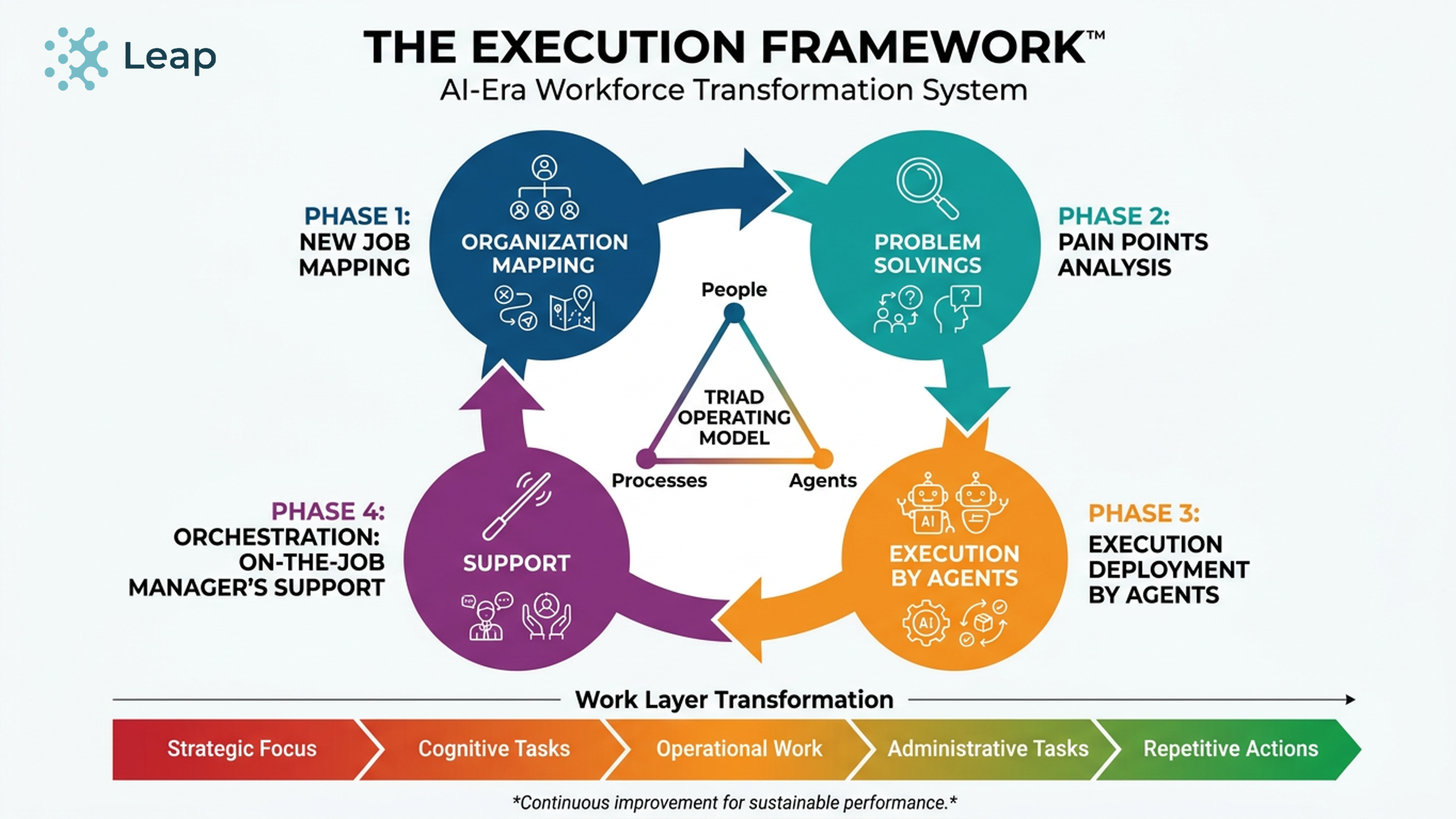
A 4-phase framework for AI implementation
A useful implementation model can be built around four phases:
New Job Mapping, Pain Points Analysis, Execution Deployment by Agents, and Orchestration / On-the-Job Manager Support. The core operating model across all phases is People + Processes + Agents.
Let’s unpack each phase.