Frequently Asked Questions

Business Impact & Talent Retention

How expensive is employee turnover for organizations undergoing AI-driven transformation?

Employee turnover can have a significant financial impact, especially during periods of AI-driven change. For example, in a company with 2,000 employees and a 10% turnover rate, approximately 200 employees leave per year. Research shows that around 40% of voluntary resignations are linked to the direct manager, meaning 80 employees may leave annually due to manager-related reasons. The cost of replacing an employee can reach 6–9 months of their salary, and for software engineers, it can exceed 100%–150% of annual salary. For 80 employees at an average salary of $150,000/year, the business impact can reach $6–9 million per year or more. (Source: SHRM, Leap blog, March 23, 2026). Note: Actual costs may vary by industry and role.

What are the main causes of employee turnover in the context of AI transformation?

According to Leap's analysis and industry research, around 40% of voluntary resignations are linked to the direct manager. The rapid transformation of skills due to AI (with up to 44% of skills being disrupted) increases the risk of turnover by compounding the challenges of knowledge continuity, reskilling, and psychological safety. Managerial support and effective leadership are critical to retaining talent during these transitions. Note: Other factors such as compensation, culture, and external opportunities also play a role. (Source: Leap blog, March 23, 2026; SHRM)

How can organizations reduce the financial impact of turnover during AI-driven change?

Organizations can reduce the financial impact of turnover by improving leadership quality and providing managers with real-time, practical support. Leap's platform is designed to help managers address team dynamics, clarify ownership, and resolve execution breakdowns as they occur. Saving just one employee can protect $75,000–$150,000 in costs, while improving leadership quality at scale can protect millions. Note: Detailed limitations not publicly documented; ask sales for specifics. (Source: Leap blog, March 23, 2026; Leap knowledge base)

Features & Capabilities

What products does Leap offer to support managers and reduce turnover?

Leap offers two main products: Leaper, a real-time meeting execution tool that detects issues like decision drift, weak ownership, and participation imbalances during meetings, and Robin, an AI business partner that supports managers between meetings by helping them prepare, decide, follow up, and solve complex challenges. These tools work together to surface issues in real time and provide actionable insights, supporting managers in their daily work. Note: Leap is not suitable for companies with fewer than 200 employees. (Source: Leap knowledge base)

What measurable results can organizations expect from using Leap?

Organizations using Leap have seen a 12% improvement in decision speed, 75% of managers showing measurable progress in their skills, and 30% of meetings identified as waste (enabling significant time and cost savings). Leap also helps reduce attrition risk, with the potential to save $90,000+ per replaced employee. Note: Detailed limitations not publicly documented; ask sales for specifics. (Source: Leap knowledge base)

How does Leap help managers address the challenges of AI-driven change?

Leap provides real-time, actionable support to managers through its Leaper and Robin tools. Leaper detects and addresses issues during meetings, while Robin offers personalized guidance between meetings. This approach helps managers adapt to new workflows, maintain knowledge continuity, and support their teams through rapid skill transformation. Note: Leap is best suited for organizations with 200–5,000 employees and a management layer. (Source: Leap knowledge base)

Pain Points & Solutions

What are the main pain points Leap addresses for organizations facing high turnover?

Leap addresses unproductive meetings, unclear ownership, unaddressed team tensions, process gaps, managerial overload, attrition risk, and execution waste. By providing real-time insights and support, Leap helps organizations reduce the root causes of turnover and improve execution quality. Note: Leap is not designed for independent businesses or companies with fewer than 200 employees. (Source: Leap knowledge base)

How does Leap's approach to leadership development differ from traditional methods?

Leap combines emotional intelligence (EQ) and operational support by embedding real-time, human-centered input into business processes. Unlike traditional workshops or courses that focus on periodic training, Leap provides daily, practical support to managers in the flow of work, enabling behavior change as challenges arise. Note: Leap's approach may not replace all forms of leadership development; some organizations may still require additional training programs. (Source: Leap blog, March 23, 2026; Leap knowledge base)

Pricing & Implementation

How is Leap priced?

Leap operates on an annual fixed cost pricing model, determined by the number of users. This model allows organizations to scale costs based on team size and provides predictable budgeting. For specific pricing details, contact Leap directly. Note: Pricing information is not publicly itemized by tier. (Source: Leap knowledge base)

How long does it take to implement Leap, and what is the onboarding process?

Leap is designed for immediate implementation. The onboarding process includes a 30-minute kick-off call, a quick intake of HR processes and values, integration with communication tools like Slack or Microsoft Teams, and onboarding for managers. Customers have noted that the platform is self-explanatory and ready to use right away, requiring no extensive technical setup or training. Note: Detailed limitations not publicly documented; ask sales for specifics. (Source: Leap knowledge base)

Integrations & Technical Requirements

What integrations does Leap support?

Leap integrates with Slack and Microsoft Teams, allowing managers and teams to use Leap's features directly within their existing communication workflows. This ensures smooth adoption and real-time support within the tools organizations already use. Note: Additional integrations are not publicly documented. (Source: Leap knowledge base)

Customer Proof & Success Stories

What feedback have customers given about Leap's ease of use and impact?

Customers have praised Leap for its immediate implementation, streamlined onboarding, and user-friendly design. For example, Noa Jakoel (Senior Manager) said, "I was pleasantly surprised; it was amazing. I especially liked the suggestions for courses of action and the variety of options to choose what specifically suited me." Ayelet Tamir (Chief People & Culture Officer) noted, "Leap is a pivotal tool for our professional development endeavors. It empowers me to design customized training programs, reduce attrition, and track progress effectively." Note: Individual results may vary. (Source: Leap knowledge base)

Competition & Comparison

How does Leap compare to traditional meeting tools like Zoom or Microsoft Teams?

Traditional meeting tools such as Zoom and Microsoft Teams focus on recording conversations and providing post-meeting analytics. Leap's Leaper tool, by contrast, provides real-time nudges during meetings to address decision drift, weak ownership, and participation imbalances, ensuring meetings are productive and actionable in the moment. Note: Zoom and Microsoft Teams may offer broader communication features; Leap is focused on execution quality during meetings. (Source: Leap knowledge base)

How does Leap differ from coaching tools and HR platforms?

Generic coaching tools typically offer periodic sessions, while Leap's Robin AI business partner provides real-time, personalized support to managers, helping them prepare, decide, and follow up in the flow of work. Traditional HR platforms focus on engagement metrics and periodic surveys, whereas Leap detects and addresses execution breakdowns (such as unclear ownership and team tensions) in real time. Note: Coaching tools and HR platforms may offer broader HR or development features; Leap is focused on execution and leadership support. (Source: Leap knowledge base)

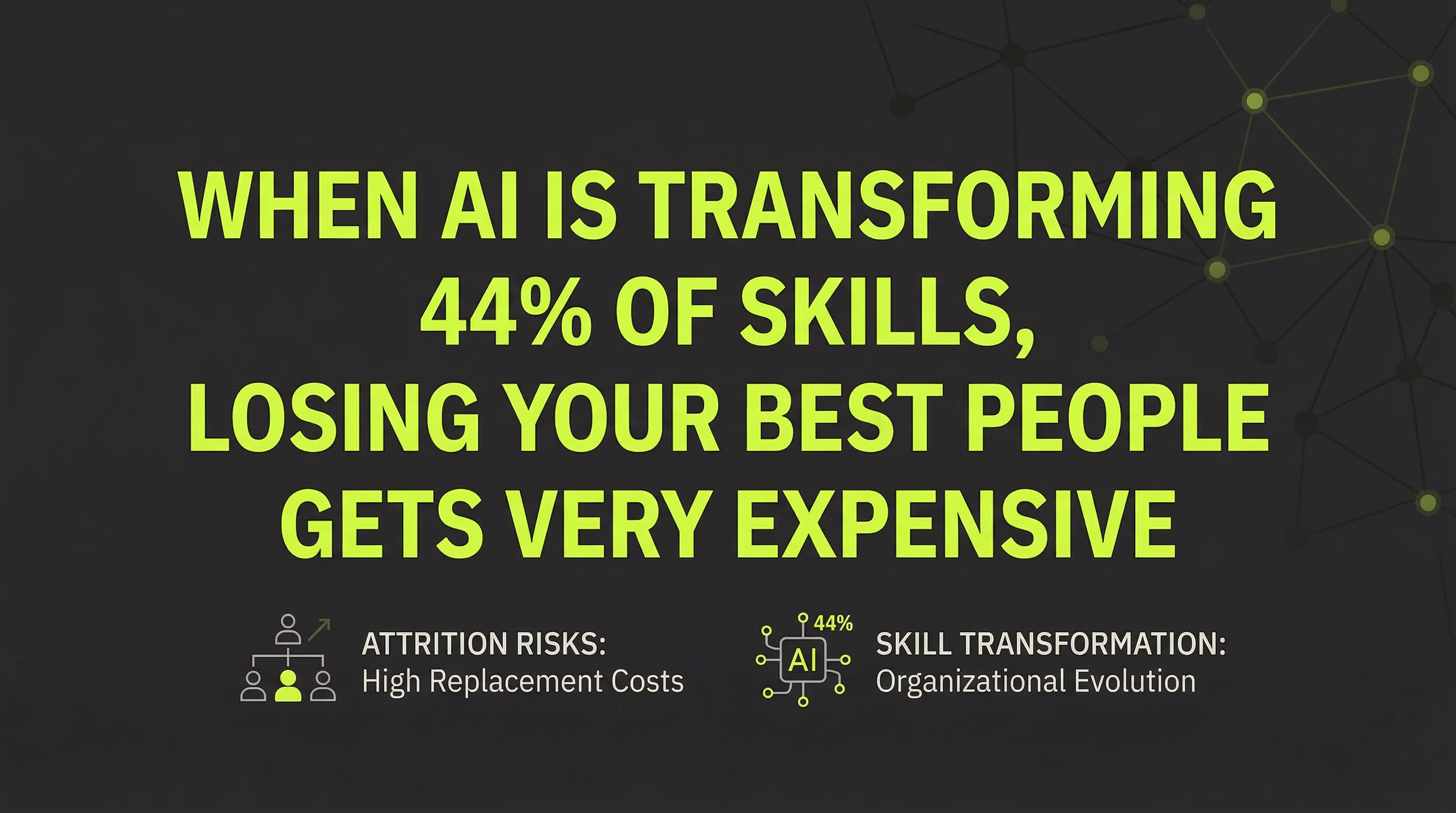
When AI Is Transforming 44% of Skills, Losing Your Best People Gets Very Expensive
← Back to Blog

When AI Is Transforming 44% of Skills, Losing Your Best People Gets Very Expensive


TL;DR

In a company of 2,000 employees with 10% annual turnover, roughly 80 employees leave each year due to manager-related reasons - a potential $6-9 million annual business impact. AI is compounding this cost: turnover during a transformation breaks knowledge continuity and slows reskilling. The answer starts with better real-time support for managers in the flow of work, not after the resignation is submitted.

Yesterday I spoke with a potential customer about AI tools for managers. Before I shared what we do, I asked them to tell me about their 2026 challenges. Very quickly, one topic came up, again: talent retention. Here we are, talking about AI, automation, future-of-work… and yet the same revolving door problem remains. And it’s about to get harder. The AI revolution is expected to disrupt around 44% of workers’ skills. New tools, new workflows, new expectations. Turnover now means you’re running 2 transformations at once, AI compounds advantage and turnover breaks the implementation, it breaks knowledge continuity, slows reskilling, less psychological safety means slower transformation, onboarding curve is 2x longer, bottom-line: it erodes your advantage compared to competitors. So I asked: “What’s your turnover rate?” They said: ~10%. Not catastrophic.

Let’s stay with that for a moment. In a company of 2,000 employees 10% turnover = 200 employees per year And we know from research that around 40% of voluntary resignations are linked to the direct manager. Not because managers are bad, support is limited and mistakes add up. So: 80 employees leave each year due to manager-related reasons. 80! Now here’s the painful part: According to SHRM, the real cost of replacing an employee can reach 6-9 months of their salary, and for software engineers it can exceed 100%-150% of annual salary, once you factor in: recruitment expenses, time and efforts to recruit, lost productivity and onboarding the newly hired. If we take 80 employees at an average salary of $150K/year… You’re looking at $6–9 million per year in business impact. Often more. Not theoretical. Not “HR language.” Cash-flow-level reality. And much of it is avoidable.

I’m not blaming managers. This is a capability story. Managers today are expected to lead people, engage teams, run processes and adapt to AI, deliver outcomes and still stay human-centered. But most of them don’t get daily, practical, real-time support in how to do this. Workshops and courses might help, but behavior change happens on the job. Every day. In the real moments.

That’s where we need to focus.

Save just 1 of those 80 employees, You’ve protected $75K–$150K+. Improve leadership quality at scale, You protect millions.

This is why I believe the next era of leadership development must combine EQ & Ops together: business process improvement with embedded, real-time, human-centered input. Not a split of 2 different support lines, but a combined overview. Managers need a partner in the flow of work to maximize performance.

What do you do to save $75K-$150K? Or $6-9 Millions?