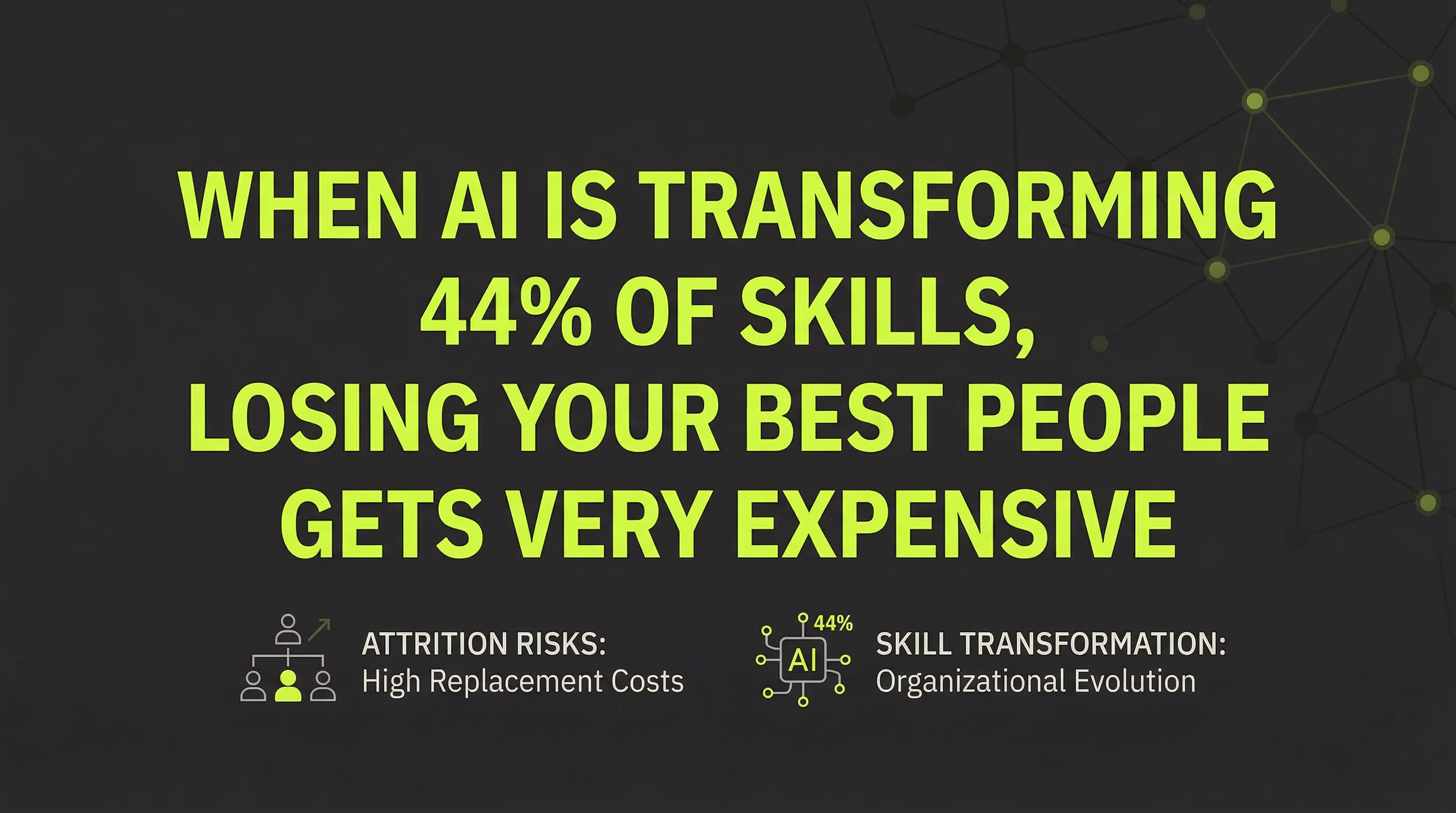
Yesterday I spoke with a potential customer about AI tools for managers. Before I shared what we do, I asked them to tell me about their 2026 challenges. Very quickly, one topic came up, again: talent retention. Here we are, talking about AI, automation, future-of-work… and yet the same revolving door problem remains. And it’s about to get harder. The AI revolution is expected to disrupt around 44% of workers’ skills. New tools, new workflows, new expectations. Turnover now means you’re running 2 transformations at once, AI compounds advantage and turnover breaks the implementation, it breaks knowledge continuity, slows reskilling, less psychological safety means slower transformation, onboarding curve is 2x longer, bottom-line: it erodes your advantage compared to competitors. So I asked: “What’s your turnover rate?” They said: ~10%. Not catastrophic.
Let’s stay with that for a moment. In a company of 2,000 employees 10% turnover = 200 employees per year And we know from research that around 40% of voluntary resignations are linked to the direct manager. Not because managers are bad, support is limited and mistakes add up. So: 80 employees leave each year due to manager-related reasons. 80! Now here’s the painful part: According to SHRM, the real cost of replacing an employee can reach 6-9 months of their salary, and for software engineers it can exceed 100%-150% of annual salary, once you factor in: recruitment expenses, time and efforts to recruit, lost productivity and onboarding the newly hired. If we take 80 employees at an average salary of $150K/year… You’re looking at $6–9 million per year in business impact. Often more. Not theoretical. Not “HR language.” Cash-flow-level reality. And much of it is avoidable.
I’m not blaming managers. This is a capability story. Managers today are expected to lead people, engage teams, run processes and adapt to AI, deliver outcomes and still stay human-centered. But most of them don’t get daily, practical, real-time support in how to do this. Workshops and courses might help, but behavior change happens on the job. Every day. In the real moments.
That’s where we need to focus.
Save just 1 of those 80 employees, You’ve protected $75K–$150K+. Improve leadership quality at scale, You protect millions.
This is why I believe the next era of leadership development must combine EQ & Ops together: business process improvement with embedded, real-time, human-centered input. Not a split of 2 different support lines, but a combined overview. Managers need a partner in the flow of work to maximize performance.
What do you do to save $75K-$150K? Or $6-9 Millions?